

Blog / Pain Science
Looking for an Injury Clinic Near You? What to Look For in Melbourne's West
A practical guide to what a good first appointment should include, what it costs you in time, and when you should see your GP or go to hospital instead.
November 2026 · 7 min read
Most people do not search for an injury clinic on day one. They search on week six. The shoulder that was supposed to settle has not settled, the back that grabbed while unloading the car still grabs every morning, and the knee that only hurt on stairs now hurts walking to the letterbox.
By the time you are typing "injury clinic near me" into your phone, you usually want three things: someone to tell you what is actually going on, something that settles it down, and a plan so you are not back here in three months. That is a reasonable expectation. Here is what that should look like in practice, and the practical details people ask us about most before they book.
A good first appointment finds the cause, not just the sore spot
The sore spot is rarely the whole story. A painful Achilles in a runner who has doubled their weekly kilometres is a loading problem. A grumbling shoulder in a warehouse picker who works overhead all day is a capacity problem. A low back that flares every Monday after a weekend on the couch is often a movement and conditioning problem wearing a pain costume.
So your first visit should spend real time on history. When did it start, what were you doing in the weeks before, what makes it better and worse, what have you already tried, what does your week actually look like for work, training and sleep. Then a physical assessment that tests the painful area and the structures above and below it, checks strength properly rather than guessing, and watches you do the thing that hurts.
That is the whole basis of how we work: find the cause, fix the problem, keep it away. If you leave your first appointment feeling better but with no explanation of why it happened, the odds of it returning are not in your favour.
You should also leave with a working diagnosis in plain English, a rough timeframe based on the tissue involved and your history, and a clear idea of what the first two to three weeks look like. Not a vague promise of "a few sessions and we will see".
Hands-on treatment and a strength plan are not two separate things
There is an old split in rehab where manual therapy sits in one room and exercise sits somewhere else, and nobody quite joins them up. We do not run that way. We work as one team on one plan, which means the hands-on work and the loading plan are built to serve each other rather than compete.
Hands-on treatment earns its place early. It can take the edge off, restore movement you are guarding, and make the next part possible. But it is the entry point, not the destination. The part that changes your odds over the following year is building capacity in the tissue that failed.
Babatunde and colleagues (2017), in a systematic overview of treatments for musculoskeletal pain in primary care, found that exercise-based approaches and combined programs had the most consistent support across common conditions, while passive treatments used alone had far weaker evidence for lasting change. That matches what we see clinically. Treatment that only ever happens to you tends to wear off. Treatment that also changes what your body can tolerate tends to stick.
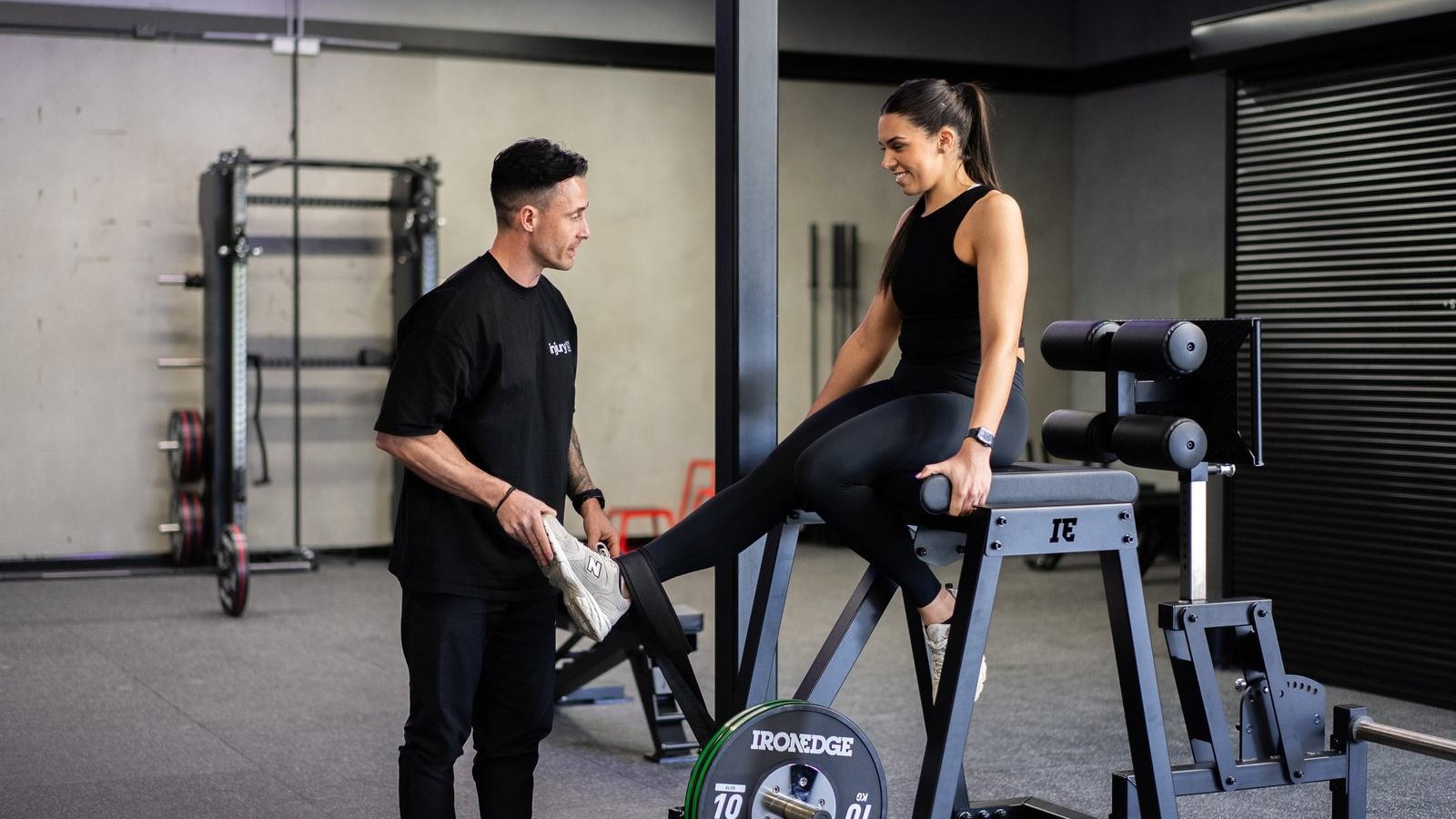
This is also why strength work is treatment in our clinic, not an optional add-on once you are "better". At Ravenhall the treatment rooms and the strength gym are in the same building, so a session can move from hands-on work straight onto a bar, a sled or a leg press without you driving anywhere. For conditions like knee pain and low back pain, that integration matters more than any single technique.
Pain does not always mean damage, and resting is rarely the answer
One of the most useful things a clinician can do is explain what your pain actually means. Moseley and Butler (2015) summarised fifteen years of pain education research showing that understanding pain biology can reduce threat, improve movement and support better outcomes. Pain is a protective output, strongly influenced by tissue state but not a direct readout of tissue damage.
Practically, that means a sore back after a disc irritation does not need six weeks on the couch. It usually needs graded, sensible movement that stays under the flare threshold while capacity rebuilds. Deconditioning and fear of movement do more long-term damage to most people's function than the original injury did.
A good clinic will tell you what is safe to keep doing, not just what to stop. Motion is medicine, and your plan should reflect that from week one.
The practical questions people ask before booking
- Do I need a GP referral? No. You can book directly for physiotherapy, myotherapy, exercise physiology or podiatry in Australia. A referral is only needed for specific funding pathways such as a Chronic Disease Management plan, WorkCover, TAC or DVA.
- Can I claim through private health? Yes, if you hold extras cover that includes the service. We process rebates on the spot through HICAPS, so you pay the gap only. Rebate amounts vary by fund and level of cover.
- How soon can I be seen? Same-day and next-day appointments are often available, particularly for acute injuries. It depends on the day and the clinic, so it is worth calling if you need something urgently.
- How long is the first appointment? Allow around 45 minutes to an hour. Assessment, explanation, initial treatment and the start of your plan do not fit into fifteen minutes.
- What should I wear? Clothing you can move in. Shorts for knee, hip or ankle problems, a singlet or t-shirt for shoulder and neck issues. Bring your running shoes or work boots if the problem is related to running, standing or walking.
- Should I bring my scans? If you have them, yes. They add context. They are also rarely the deciding factor, because imaging findings are common in people with no symptoms at all.
When to see your GP or go to hospital instead
An injury clinic is the right place for most musculoskeletal problems, but not all of them. Serious pathology is uncommon in this setting. Henschke and colleagues (2009) found that fewer than one percent of patients presenting to primary care with acute low back pain had a serious underlying cause. Uncommon is not never, which is why screening matters.
Go to your nearest emergency department or call 000 if you have any of the following:
- Loss of bladder or bowel control, or numbness around the groin and inner thighs
- Rapidly progressing weakness in a limb
- Severe pain after significant trauma, or an obvious deformity or inability to weight bear
- Chest pain, shortness of breath, or a hot, swollen, painful calf
- Severe back pain with fever, or unexplained weight loss, particularly with a history of cancer
See your GP first if your pain is accompanied by systemic illness, if it is clearly not mechanical in nature, or if you need medication review. We screen for these things at every initial assessment and will refer on where it is appropriate. Finding the cause sometimes means recognising that the cause is not ours to treat.
Where we are in Melbourne's west
We run two clinics across Melbourne's west.
Ravenhall is at 38 Panamax Road, about five minutes from Caroline Springs and easy to reach from Deer Park, Burnside, Rockbank, Melton, Derrimut, Truganina, Tarneit, Taylors Hill and Sunshine. This is the site with the on-site strength and conditioning gym, so it suits anyone whose plan involves heavier loading, return to sport or return to physical work. Details are on the Ravenhall clinic page.
Altona is at 22 Reserve Court, inside Movement Culture, serving Altona North, Altona Meadows, Seaholme, Laverton, Newport, Williamstown, Spotswood, Yarraville and Point Cook. Patients who previously saw us in Williamstown now see the same team here. Details are on the Altona clinic page.
Wherever you start, you are seeing one team working from one plan. Your assessment, your hands-on work and your loading program are built together, not stitched together after the fact.
If something has been hanging around longer than it should, or you keep managing the same injury every few months, that pattern usually has a reason behind it. Book a consultation at any of our Melbourne clinics to discuss your situation.
Related conditions & services
Ready to move better?
Book an appointment with our team and let's get to the root cause of what's bothering you.