
Blog / Knee Pain
Knee Pain Treatment in Caroline Springs: Evidence-Based Care at Injury Active Clinic Ravenhall
Why most knee pain is a loading problem, not a wear and tear sentence, and how a single coordinated plan gets you back to walking, running and lifting.
August 2026 · 7 min read
Knee pain has a habit of creeping in. It starts as a niggle going down the stairs at home in Caroline Springs, then it shows up on the walk around the lake, then it is there when you stand up from the couch. By the time most people book in, they have already spent months modifying: shorter walks, no squats, the lift instead of the stairs. The knee gets quieter, but it also gets weaker, and the cycle tightens.
Injury Active Clinic's Ravenhall clinic sits just minutes from Caroline Springs and serves the whole catchment across Burnside, Deer Park, Rockbank and Taylors Hill. We see knee pain every day, in office workers, tradies, weekend runners and people in their sixties and seventies who have been told the knee is simply worn out. The approach is the same regardless: find the cause, fix the problem, keep it away.
Why knee pain is so common in Caroline Springs
Nothing about the suburb causes knee pain. What causes it is the pattern of life around here, and it is a very consistent pattern. Long commutes into the city or across the west mean a lot of sitting. Estates built for walking mean people go from very little activity to a sudden 8,000 step day. Local footy, netball, basketball and the growing park run and gym culture mean load spikes on a body that has been sedentary five days a week.
Knees do not usually fail because they are fragile. They complain when the demand placed on them outpaces the capacity they currently have. That gap can open up in two ways: demand rises quickly (a new training block, a house renovation, a new job on your feet), or capacity falls quietly (a desk-bound year, an old injury never properly rehabilitated, a period of illness). Most knee pain we assess in the Caroline Springs area sits squarely in one of those two stories.
What is actually driving your knee pain
"Knee pain" is a location, not a diagnosis. Several distinct presentations account for the majority of what we see, and they respond to quite different loading strategies.
- Patellofemoral pain. Pain around or behind the kneecap, worse with stairs, hills, squatting and prolonged sitting. Common in runners and in people who have recently increased walking volume. The 2018 international consensus statement led by Collins and colleagues supports exercise therapy targeting the hip and knee as the core intervention.
- Patellar or quadriceps tendinopathy. Sharp, well-localised pain at the bottom of the kneecap, provoked by jumping, decelerating and change of direction. Work by Rio and colleagues (2015) showed that heavy isometric loading may reduce tendon pain in the short term and allow rehabilitation to progress.
- Knee osteoarthritis. Stiffness after rest, ache with prolonged load, sometimes swelling. Very treatable. It is not a countdown clock.
- Meniscal irritation and post-traumatic knee pain. Often manageable conservatively, particularly degenerative meniscal changes in mid-life and beyond.
- Referred or contributing problems. Hip weakness, poor ankle range, or an old back or foot injury that has quietly changed how you load the leg.
You can read more about the presentations we assess on our knee pain conditions page. The point of a thorough assessment is not to attach a label. It is to work out which tissue is irritated, why it became irritated, and what has to change so it does not happen again.
Pain does not equal damage: what the scan does not tell you
This is the conversation we have most often, and it matters. Imaging findings on knees are extremely common in people with no pain at all. Culvenor and colleagues (2019) published a systematic review showing that features such as cartilage defects, meniscal tears and osteophytes appear frequently on MRI in uninjured, pain-free adults, including in people under 40. Degenerative changes are, to a significant degree, a normal part of ageing tissue rather than proof of a broken joint.
That does not mean your pain is imaginary. It means the picture on the scan is only one input, and often not the most useful one. What tends to predict how well someone does is strength, movement confidence, activity levels and how much they believe their knee can tolerate. When people are told their knee is bone on bone, they move less. Moving less reduces muscle support, joint nutrition and tolerance, which makes the knee hurt more. Fear-avoidance is a genuine driver of ongoing pain, not a personality flaw.
Motion is medicine here. Load, applied at the right dose and progressed sensibly, is one of the few things that actually changes the underlying capacity of the joint and the muscles around it.
Strength and conditioning is the treatment, not the reward
There is a persistent idea that you do hands-on treatment first, get the pain down, and then maybe do some strengthening later if you feel like it. That sequence gets it backwards.
The evidence base for exercise in knee pain is one of the strongest in musculoskeletal care. Fransen and colleagues' Cochrane review (2015) found that land-based therapeutic exercise provides benefit for pain and physical function in knee osteoarthritis. Skou and Roos (2017) reported on the GLA:D programme, a structured education and neuromuscular exercise approach, with participants showing reduced pain, improved function and lower reliance on painkillers. OARSI guidelines (Bannuru and colleagues, 2019) place exercise and education at the centre of care for knee osteoarthritis, ahead of passive options.
So we treat strength work as the intervention itself. Hands-on therapy has a real role: it may reduce pain and stiffness, restore range and make loading tolerable in the early weeks. It works best as the thing that opens the door, with progressive loading as the thing that walks you through it.
How we treat knee pain at IAC Ravenhall
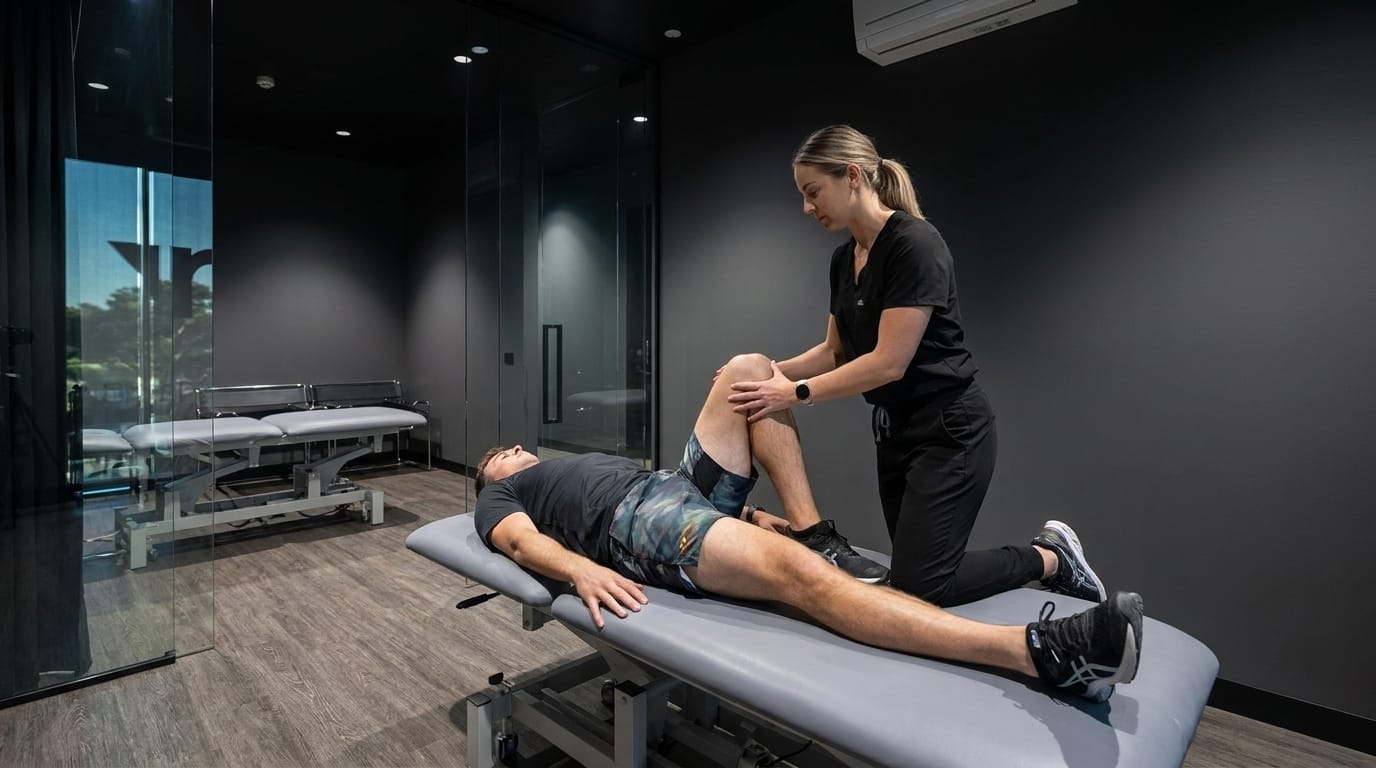
Your first appointment is an assessment, not a quick rub and a set of printed exercises. We take a proper history: when it started, what provokes it, what your week actually looks like, what you have already tried, what you want to get back to. Then we test. Strength through the hip, knee and calf. Range at the ankle and hip. How you squat, step down, walk and load single leg. We are looking for the gap between what your knee is being asked to do and what it can currently do.
From there you get one plan, delivered by one integrated team under one roof. We do not hand you between separate services or send you elsewhere to do the exercise part. Ravenhall houses the clinic and a full rehab gym in the same building, so the transition from treatment table to loading is a walk across the room, not a referral. Early sessions typically blend hands-on work to settle symptoms with specific loading you can actually tolerate. As the knee responds, the balance shifts and the gym becomes the main event: progressive strength, single leg control, and eventually the running, jumping or lifting demands that matter to your life.
That structured loading sits under our exercise physiology approach, and it is deliberately measured. We retest strength and function so progress is objective rather than a guess. Most people notice meaningful change over a 6 to 12 week block, though timelines vary considerably depending on how long the problem has been running and what you are aiming for. Individual results differ, and we will be honest with you about what we are seeing.
The last part is the part most programmes skip. Keeping it away means knowing your maintenance dose: what strength you need to hold, how to manage a training spike, what to do if it flares. That is the difference between fixing an episode and fixing the problem.
Getting to Ravenhall from Caroline Springs
Ravenhall is a short drive from Caroline Springs via the Western Freeway, with on-site parking and appointments available before and after work. We also have a clinic in Altona at 22 Reserve Court for anyone closer to the bay. If you are unsure whether your knee needs assessment yet, a reasonable rule of thumb is this: pain lasting beyond 2 to 3 weeks, pain that is changing how you walk, or a knee that keeps flaring every time you try to build activity all deserve a proper look.
Knee pain in Caroline Springs does not have to be something you manage around for years. Most of the time it is a capacity problem with a clear path forward.
Book a consultation at any of our Melbourne clinics to discuss your situation.
Related conditions & services
Ready to move better?
Book an appointment with our team and let's get to the root cause of what's bothering you.