
Blog / Shoulder Pain
Shoulder Pain Treatment in Caroline Springs: Evidence-Based Care at Injury Active Clinic Ravenhall
Why shoulder pain hangs around for months, and what actually shifts it.
August 2026 · 7 min read
Shoulder pain is one of those problems people put up with for far too long. It starts as a niggle when you reach for the seatbelt or lift a bag into the boot. Six weeks later you are sleeping on one side only, avoiding the top shelf, and quietly dropping the gym sessions that involve pressing overhead. If you live in Caroline Springs and your shoulder pain has settled into that pattern, you are not unusual. You are just past the point where waiting it out tends to work.
Our nearest clinic to Caroline Springs is Injury Active Clinic Ravenhall, a short drive up the road and the clinic that serves most of the Caroline Springs, Burnside, Deer Park and Rockbank catchment. Below is how we think about shoulder pain, what the research actually supports, and what care looks like when hands-on treatment and loaded rehab happen under one roof.
Why shoulder pain in Caroline Springs so often drags on
Shoulder complaints have a reputation for being stubborn, and the research backs that up. Long-running cohort work following people with new shoulder complaints in primary care has consistently found that a substantial proportion still report symptoms six to twelve months later. Bruls and colleagues (2015) reviewed the prognostic literature on neck and shoulder complaints and found recovery is far from guaranteed, with longer symptom duration before seeking care being one of the more consistent predictors of a slower outcome.
There is a mechanical reason for this. The shoulder is the most mobile joint in the body and it borrows its stability from muscle rather than bone shape. When the rotator cuff and the muscles controlling the shoulder blade lose capacity, the joint keeps working but it works less efficiently. You compensate by shrugging, by leaning, by using the arm in a narrower range. Every one of those compensations feels sensible in the moment and every one of them makes the shoulder a little less capable over time.
Add in the everyday realities of west Melbourne life: long commutes with the arm parked on a console, desk work, kids to lift, renovations, weekend cricket or basketball after a five-day break. The shoulder rarely gets a genuine rest, but it also rarely gets genuinely loaded. That combination is fertile ground for persistent pain.
What is usually going on in a painful shoulder
Most shoulder pain we see falls into a handful of presentations, and they behave differently.
- Rotator cuff related shoulder pain. The most common one. Pain on reaching, lifting or overhead work, often referred into the outer arm, usually worse at night. Lewis (2016) proposed this broader label precisely because the older mechanical labels implied a level of diagnostic precision that imaging and clinical testing cannot reliably deliver.
- Frozen shoulder (adhesive capsulitis). Marked stiffness in all directions, particularly rotating the arm outwards. It follows a long, phasic course and needs a different plan.
- Shoulder blade and neck driven pain. Pain felt at the shoulder but generated or amplified further up the chain. Treating only the sore spot in these cases tends to disappoint.
- Instability and post-injury shoulders. Often younger, often sport related, often after a dislocation or heavy fall.
Working out which pattern you are dealing with is the whole game, and it is why we spend the first appointment testing rather than guessing. You can read more about how we assess and categorise these presentations on our shoulder pain condition page.
Pain does not equal damage, and rest is rarely the fix
Scans have a lot to answer for here. Rotator cuff tendon changes and partial tears are extremely common in people with no shoulder pain at all, and the prevalence climbs steadily with age. A finding on an ultrasound or MRI is a piece of information, not a verdict, and it correlates poorly with how much pain you are in or how well you will respond to treatment.
The surgical literature reinforces the point. Beard and colleagues (2018) published the CSAW trial in The Lancet, comparing subacromial decompression surgery with a placebo arthroscopy and with no treatment. The differences between the surgical and placebo groups were small and of questionable clinical importance. Karjalainen and colleagues (2019) reached a similar conclusion in a Cochrane review. This does not mean surgery never has a role. It means the structural story we were told for decades explains less than we assumed, and that loading the shoulder well explains more.
Which brings us to the useful part. Steuri and colleagues (2017), in a systematic review published in the British Journal of Sports Medicine, found exercise to be effective for pain and function in shoulder impingement type presentations, with manual therapy providing added benefit when combined with exercise. Littlewood and colleagues have shown that progressive loading programs for rotator cuff tendinopathy produce meaningful improvement without needing a complicated setup. Haik and colleagues (2016) reported comparable findings for combined manual therapy and exercise approaches.
The consistent theme is that motion is medicine. Shoulders that are protected, guarded and unloaded get weaker, more sensitive and more irritable. The aim is not to avoid load. It is to find the load your shoulder can currently tolerate and then build from there.
How we treat shoulder pain at IAC Ravenhall
Our approach is straightforward: we find the cause, we fix the problem, we keep it away. That is one plan delivered by one integrated team, not a series of separate appointments that never quite connect.
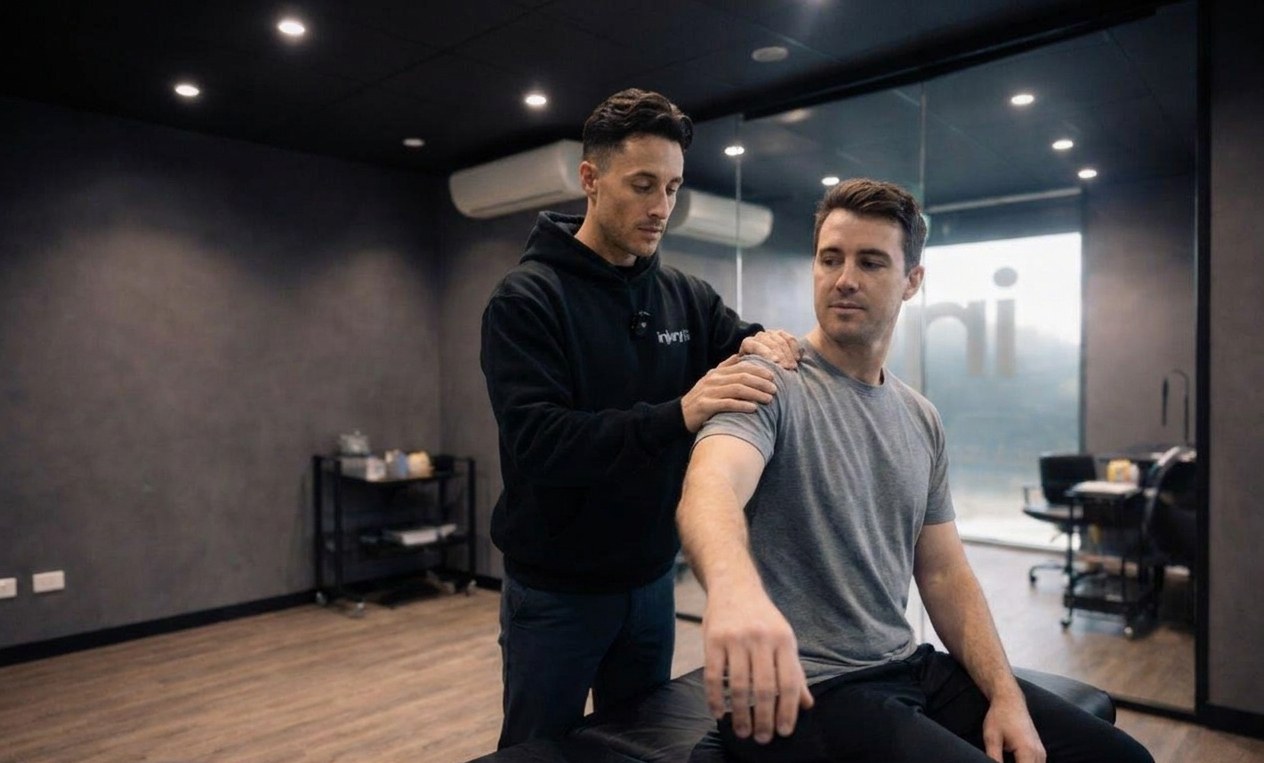
A first appointment at Ravenhall runs about an hour. We take a proper history: how it started, what aggravates it, how you sleep, what you do for work, what you have already tried. Then we test. Range of motion in every direction, strength testing of the rotator cuff at different angles, shoulder blade control, neck screening, and symptom modification testing where we change how you move and see what happens to your pain in real time. That last part is often the most informative thing we do, because a shoulder that behaves differently when we change its mechanics tells us there is something to work with.
From there you leave with a working explanation of what is driving your pain, a clear idea of what recovery is likely to involve, and something to start on that day. Early treatment usually blends hands-on work to settle irritability and restore movement with loading you can actually manage. Our myotherapy approach is a big part of that early phase, particularly where guarding, stiffness and referred pain through the neck and shoulder blade are limiting how much you can move.
What matters most is what happens next. At Ravenhall the treatment rooms and the rehab gym are in the same building, so progressing from hands-on care into loaded rehabilitation is not a referral or a handover. It is the same plan, the same team, the same file, just a different stage. You move from restoring range, to building rotator cuff strength, to loading overhead and under fatigue, to whatever your actual life demands. Nothing about the plan changes hands.
Strength work is the treatment, not the extra bit
People often assume rehab exercise is what you do once the pain has gone. We treat it as the treatment itself. Progressive strength and conditioning is the most reliable tool we have for changing tissue capacity, and capacity is what determines whether a shoulder stays settled when you go back to real loads.
Practically, this means we do not stop at a resolved symptom. If you play basketball at Caroline Springs on a Thursday night, the endpoint is not pain-free reaching in a clinic room. It is a shoulder that holds up in the fourth quarter. If you work overhead on tools, the endpoint is a full shift. Expect the process to take 6 to 12 weeks for most rotator cuff presentations, sometimes longer if it has been grumbling for a year or more, and expect the load to keep climbing across that time rather than plateauing.
We also spend time on the fear-avoidance piece, because it matters. Many people find that once they understand pain does not automatically mean damage, they stop protecting the shoulder unnecessarily, and progress accelerates.
Getting shoulder pain assessed near Caroline Springs
Sooner is better. If your shoulder pain has lasted more than two or three weeks, is waking you at night, or is changing what you are willing to do with your arm, that is a reasonable point to have it properly assessed rather than waiting to see if it settles. Sudden loss of strength after a fall, significant unexplained swelling, or pain accompanied by fever or feeling generally unwell warrants prompt medical review instead.
Injury Active Clinic Ravenhall is the closest of our clinics for Caroline Springs residents, with the clinic and rehab gym on the same site so shoulder pain treatment does not get split across locations. Parking is on site and appointments are available across the week.
Book a consultation at any of our Melbourne clinics to discuss your situation.
Related conditions & services
Ready to move better?
Book an appointment with our team and let's get to the root cause of what's bothering you.