

Blog / Knee Pain
Knee Pain and Quadriceps Strength: Why Your Thighs Hold the Key
The evidence shows quad strength matters more than almost anything else for knee pain
July 2026 · 6 min read
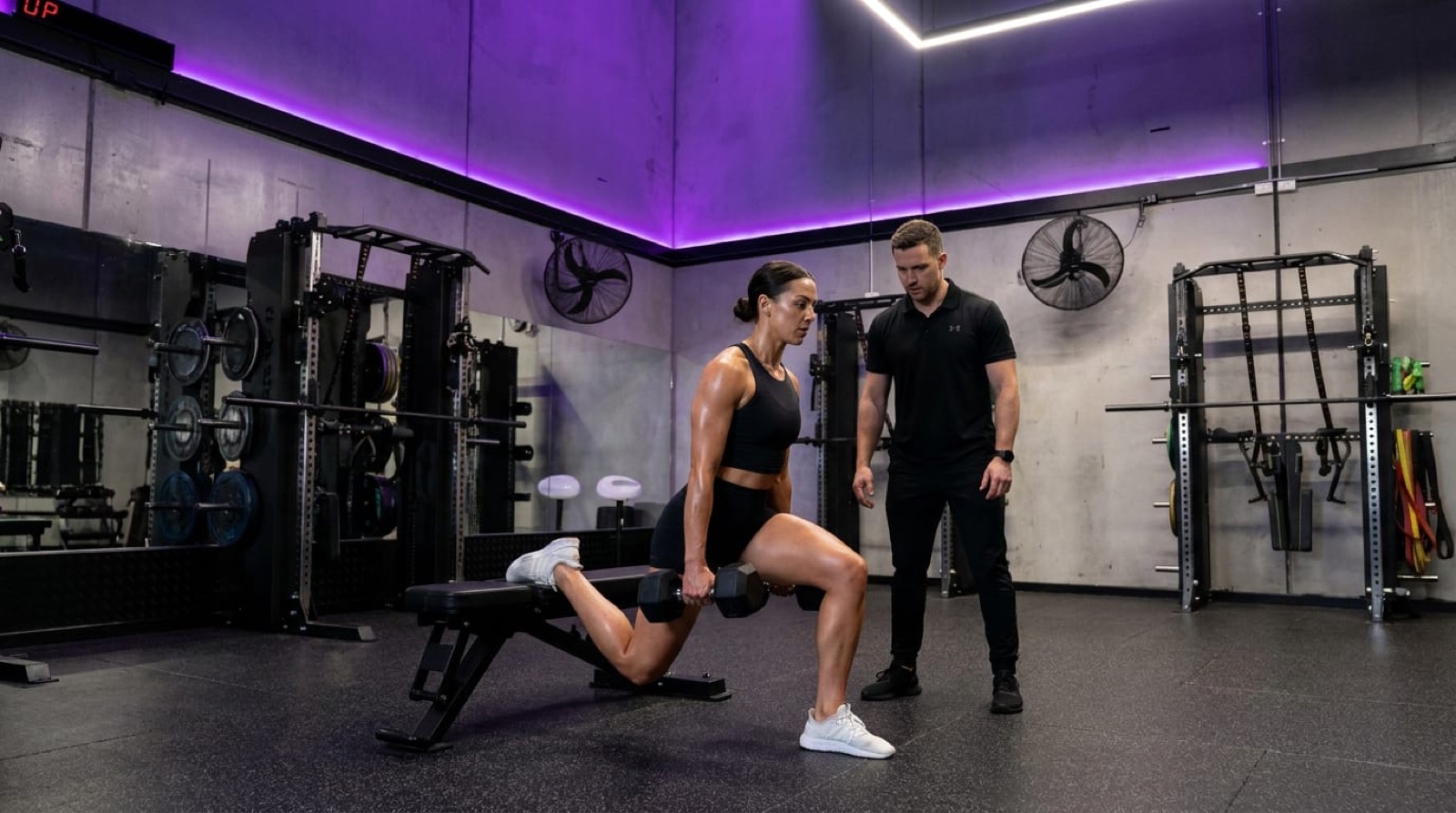
Your knee hurts. Maybe it's been building for months, or perhaps it started after that longer run last weekend. You've tried rest, ice, maybe some anti-inflammatories. The pain comes back. Here's what the research tells us: the strength of your quadriceps muscles matters more for knee pain outcomes than almost any other factor you can control.
This isn't about building bigger legs for aesthetics. It's about understanding that your quadriceps act as shock absorbers, load distributors, and joint stabilisers all at once. When they're weak, your knee joint takes more stress with every step. When they're strong, they protect the joint and often reduce pain significantly, even in conditions like osteoarthritis where structural changes are permanent.
The Evidence Is Clear: Quad Strength Predicts Knee Pain Outcomes
Research on knee pain consistently points to quadriceps weakness as both a cause and consequence of knee problems. Øiestad and colleagues (2015) followed over 3,000 people and found that those with stronger quadriceps had significantly less knee pain progression over two years, regardless of their starting point or existing joint changes on imaging.
For patellofemoral pain syndrome (runner's knee), the evidence is even stronger. Van der Heijden et al (2015) showed that progressive quadriceps strengthening reduced pain by 40 to 60 percent in most patients, outperforming passive treatments like taping or manual therapy alone. The key word here is progressive: gradually increasing load over time, not just doing the same exercises forever.
What makes this particularly interesting is that strength training helps even when structural damage exists. In knee osteoarthritis, where cartilage loss is irreversible, quadriceps strengthening still reduces pain and improves function. This supports what we know from modern pain science: pain doesn't equal damage. Your experience of pain involves multiple factors, and muscle weakness is one you can actually change.
Why Your Quads Matter So Much for Knee Health
Your quadriceps do more than just straighten your knee. They control how forces travel through your knee joint with every step, squat, or stair climb. When you land from a jump or decelerate while running, your quads absorb massive forces that would otherwise hammer your joint surfaces.
Think of your quadriceps as your knee's primary brake system. Without adequate strength, every deceleration becomes a jarring impact. Your patella (kneecap) gets compressed harder against the femur. Your menisci take more load. Your ligaments work overtime. Over weeks and months, this extra stress adds up.
The vastus medialis oblique (VMO), the teardrop-shaped muscle on your inner thigh, gets particular attention in knee rehab. While all four quad muscles matter, the VMO helps control patellar tracking. When it's weak or fires late, your kneecap may not glide smoothly, contributing to anterior knee pain. But here's the thing: you can't really isolate the VMO. Effective quad strengthening trains all four muscles together through progressive loading.
Hip strength matters too. Your glutes control your thigh bone's position, which affects how forces reach your knee. Weak hip abductors let your knee collapse inward during walking or running, multiplying stress on certain structures. That's why comprehensive knee pain treatment addresses both quad and hip strength together.
Load Tolerance Beats Rest: Why Movement Is Medicine
The old advice was simple: if your knee hurts, rest it. We now know this often makes things worse. Rest leads to muscle weakness, which increases joint stress when you do return to activity. It's a vicious cycle that keeps many people stuck in recurring pain episodes.
Modern rehabilitation follows a different principle: motion is medicine. Instead of avoiding load completely, we modify it to a tolerable level, then gradually build up. This approach maintains muscle mass, preserves movement patterns, and actually helps tissue healing through controlled stress.
Load tolerance means finding the right amount of challenge for your current capacity. Maybe you can't squat to parallel without pain, but you can do a quarter squat. Start there. Maybe running hurts, but cycling doesn't. Use the bike to maintain quad strength while you rebuild capacity. The goal isn't to push through severe pain, but to find the movement you can do and progressively expand from there.
This approach requires patience and precision. Too much load too soon flares symptoms. Too little maintains weakness. The sweet spot involves consistent, gradual progression based on your response, not arbitrary timelines. We find the cause, we fix the problem, we keep it away by building your capacity systematically rather than just treating symptoms.
What Progressive Quad Loading Actually Looks Like
Effective quadriceps strengthening for knee pain doesn't mean jumping straight to heavy squats. It starts where you are and builds systematically. Here's what progressive loading might look like in practice, though your specific program depends on assessment findings:
Early phase (weeks 1 to 4): Isometric holds reduce pain while building strength. Wall sits, straight leg raises, and quad sets create muscle tension without joint movement. These exercises often reduce pain immediately through a phenomenon called exercise-induced analgesia. Start with 30 to 45 second holds, building to multiple sets.
Building phase (weeks 4 to 8): Add movement through partial ranges. Mini squats, step-ups to a low box, leg press through limited range. The key is controlling descent speed (eccentric emphasis) which builds strength efficiently. Three sets of 12 to 15 reps, focusing on perfect form rather than load.
Loading phase (weeks 8 to 12): Increase range and resistance. Full squats, weighted step-ups, single-leg work. This is where strength really develops. Three to four sets of 8 to 12 reps with challenging weight, always respecting your symptom response.
Integration phase (ongoing): Sport-specific or activity-specific training. Jumping, cutting, running mechanics. This isn't separate from treatment; strength and conditioning IS the treatment. Your rehab becomes your ongoing training program.
Throughout this progression, hip strengthening runs parallel. Clamshells, bridges, and lateral walks address the hip abductors and external rotators that control knee position. Balance work on unstable surfaces challenges proprioception. It's all part of one integrated approach, not separate treatments by different providers.
Common Mistakes That Keep People Stuck
Many people with knee pain make similar errors that prevent recovery. Understanding these helps you avoid the common pitfalls:
Stopping at symptom relief: Your knee feels better after a few weeks of exercises, so you stop. But you haven't built enough strength reserve to handle your normal activities. Pain returns with increased load, and you're back where you started.
Avoiding meaningful load: Theraband exercises and bodyweight movements have their place early on. But if you never progress to actual resistance training, you won't build the strength needed for lasting change. Your muscles need progressive overload to adapt.
Fearing the gym: Many people with knee pain avoid gyms, thinking they need to be fixed first. But the gym is where fixing happens. With proper guidance, equipment like leg press machines actually let you load your quads safely while controlling range and resistance precisely.
Ignoring movement quality: Loading poorly performed movements reinforces problems. Your knee collapsing inward during squats, excessive forward lean, or bouncing through reps all matter. Quality before quantity, always.
Expecting linear progress: Strength building involves fluctuations. Some weeks feel harder. Minor flares happen. This is normal adaptation, not failure. Consistency over months matters more than perfect weeks.
Integrating Hands-On Treatment with Strength Work
While strengthening forms the foundation of lasting knee pain resolution, hands-on treatment plays an important supporting role. Manual therapy can reduce pain and improve movement quality, creating a better environment for strength training. But it's not about choosing between hands-on work OR exercises.
At our Ravenhall clinic, the treatment room and rehab gym exist in the same building for a reason. You might receive soft tissue work to address quad tightness, then immediately perform loaded exercises while tissues are mobile. Joint mobilisation might improve knee flexion, followed by squats through that newly gained range. It's one integrated team working from one unified plan, not separate treatments hoping to add up to a result.
This integration extends to your broader management. Sleep quality affects tissue recovery and pain sensitivity. Stress impacts muscle tension and movement patterns. Nutrition influences tissue healing and energy for training. Effective treatment considers all these factors without overwhelming you with disconnected advice. The team coordinates to address what matters most for your specific situation.
The evidence supports this integrated approach. Studies combining manual therapy with exercise consistently show better outcomes than either alone. But the exercise component drives the lasting change. Hands-on work facilitates better movement; strength training cements it.
Ready to build the quadriceps strength that protects your knees long-term? Book a consultation at any of our Melbourne clinics to discuss your situation.
Related conditions & services
Ready to move better?
Book an appointment with our team and let's get to the root cause of what's bothering you.