
Blog / Pain Science
Manual Therapy Alone Will Not Fix You: Here Is Why
Hands-on treatment is a powerful part of the toolkit. On its own, it rarely creates lasting change.
October 2026 · 6 min read
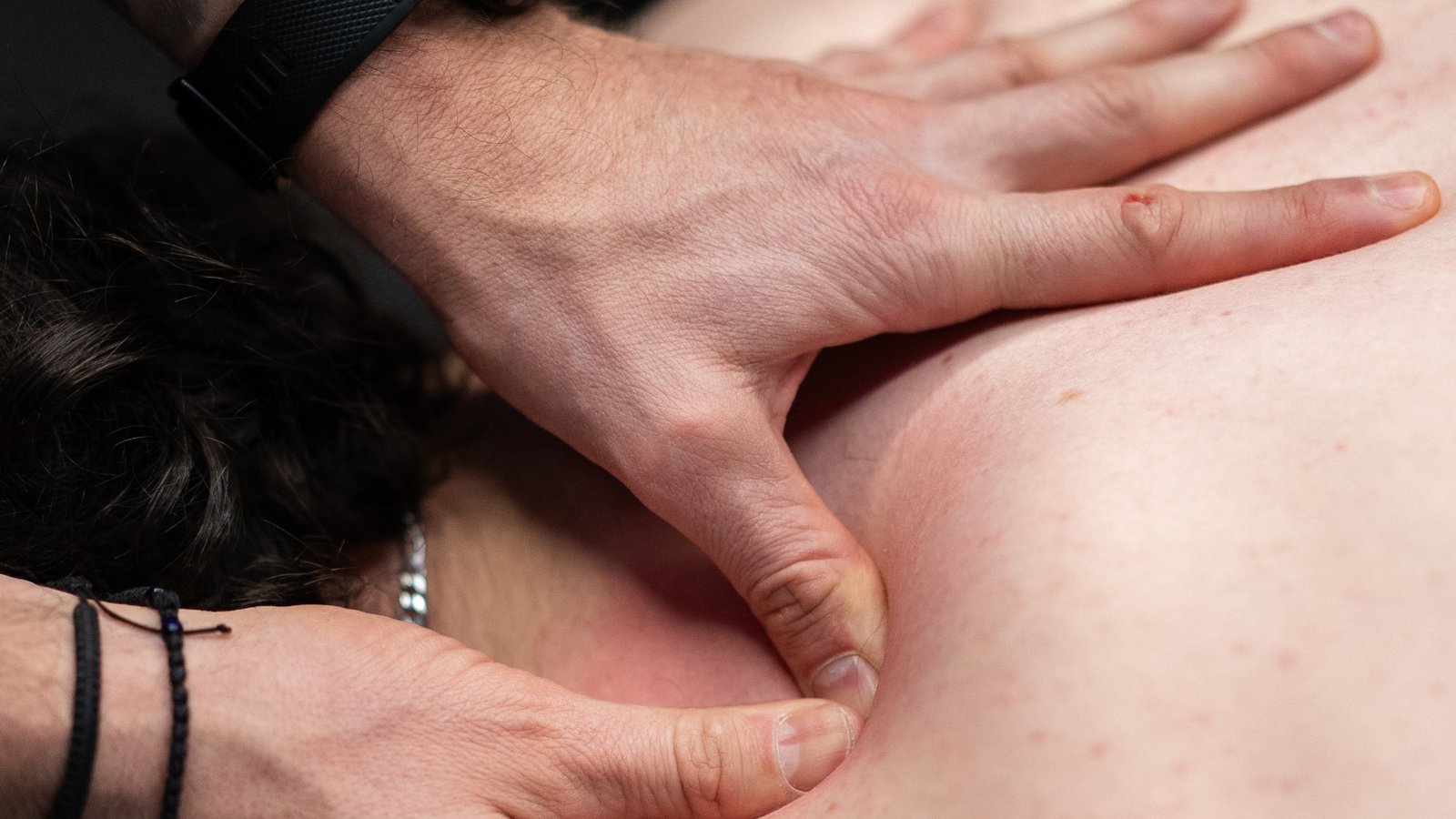
You know the pattern. You get treated, you walk out feeling loose and light, and for two or three days everything is fine. Then the ache creeps back into the same spot. You book again. Six months later you are still booking, still loose for three days, still stuck.
That cycle is not a failure of hands-on therapy. It is a failure of hands-on therapy being asked to do a job it was never designed to do alone.
At Injury Active Clinic we use plenty of manual therapy. We also think it is one tool in a much bigger box, and the research agrees. Here is what is actually happening on the table, what the evidence says about passive care on its own, and why loading your body is the part that makes the change stick.
What Hands-On Treatment Is Actually Doing
There is a popular story that manual therapy puts things back in place, breaks up scar tissue, or realigns a pelvis. That story is comforting and it is mostly wrong.
Bialosky and colleagues (2009) proposed what is now the dominant model for how manual therapy works: the effects are largely neurophysiological. Pressure, movement and joint loading send a flood of input into the nervous system, which changes how the spinal cord and brain process signals from that area. The result can be reduced pain sensitivity, reduced muscle guarding and improved tolerance to movement.
That is genuinely useful. If your back is so protective that you cannot bend forward, nothing productive is happening. Manual therapy can open a window where movement feels available again.
But notice what it is not doing. It is not lengthening a muscle permanently. It is not dissolving adhesions. It is not changing the structure of a joint. Which is exactly why the effect tends to fade: nothing about your capacity has changed, only your current sensitivity.
What the Research Says About Passive Care on Its Own
The evidence on manual therapy is not bad. It is just modest, and it is short.
Rubinstein and colleagues (2019), in a large systematic review published in the BMJ, found that spinal manipulative therapy for chronic low back pain produced similar effects to other recommended treatments, with small improvements in pain and function over the short term. Paige and colleagues (2017), writing in JAMA on acute low back pain, reported modest improvements in pain and function compared with sham or alternative treatments.
Modest and short-term is a reasonable result for a single intervention. The problem is when that intervention is the entire plan.
The 2018 Lancet low back pain series, led by Foster and colleagues, made the point bluntly: passive treatments delivered in isolation are not where the value sits. Active approaches, education and graded loading sit at the centre of modern guidelines, with hands-on care as an adjunct that helps people get moving sooner.
That is how we read it too. Hands-on work buys you a window. What you do inside that window decides whether the problem comes back.
Pain Does Not Equal Damage, and That Changes Everything
One of the most stubborn beliefs we see is that pain is a reliable readout of tissue damage. If it hurts, something must be broken, so the safest move is to protect it and get it treated.
The imaging evidence makes that hard to defend. Brinjikji and colleagues (2015) reviewed spinal imaging in people with no back pain at all and found disc degeneration in roughly 37 per cent of asymptomatic 20 year olds, climbing steadily with age until it is present in the overwhelming majority of people in their seventies. Disc bulges, annular fissures and facet changes are extremely common in people who feel completely fine.
Moseley and Butler (2015), summarising fifteen years of pain education research, described pain as a protective output influenced by tissue input, context, beliefs and prior experience. Not a damage meter.
This matters for the manual therapy conversation because of what happens next. If you believe you are fragile, you move less. Moving less means losing strength, losing tolerance and losing confidence. A body with less capacity gets provoked by smaller and smaller demands, which confirms the belief that you are fragile. That is the deconditioning spiral, and no amount of time on a treatment table reverses it.
Motion is medicine. Not as a slogan, as a mechanism.
Strength and Conditioning Is the Treatment, Not the Homework
Here is where we differ from the model most people have experienced. Exercise is not something we hand you on a photocopied sheet at the end of a session. Loading is the treatment. The hands-on work exists to make the loading possible.
The evidence base for this is deep and it spans body regions:
- Hayden and colleagues (2021), in a Cochrane review of exercise therapy for chronic low back pain, found exercise produced meaningful improvements in pain and function compared with no treatment and with usual care.
- Fransen and colleagues (2015), reviewing land-based exercise for knee osteoarthritis, found reductions in pain and improvements in physical function, with benefits sustained for several months after programs finished.
- Beyer and colleagues (2015) compared heavy slow resistance training with eccentric training for Achilles tendinopathy and found both improved outcomes at 12 weeks, with higher patient satisfaction in the heavy slow resistance group.
Notice the pattern. Progressive, meaningful load. Not stretching. Not three sets of ten with a yellow band forever. Real tissue adaptation requires real stimulus, delivered progressively, and that is the part that builds capacity you keep.
This is what we mean when we say strength and conditioning is treatment. Whether the issue is a cranky low back, a tendon that flares every time you ramp up running, or a shoulder that will not tolerate overhead work, the exit strategy is almost always a body that can handle more than it could before.
One Team, One Plan, One Building
The reason passive care often stays passive is structural. You see one person for hands-on work, you get sent somewhere else for exercise, nobody is talking to anybody, and the plan quietly becomes whatever is easiest to book.
We built Injury Active Clinic to remove that gap. We operate as one integrated team under one plan, not a collection of separate services you get handed between. The assessment, the hands-on work, the loading program and the return to sport or work criteria are all part of a single file with a single direction.
At our Ravenhall clinic the treatment rooms and the rehab gym are in the same building, so the handover from table to barbell happens in the same session rather than in a different suburb six weeks later. Our Altona clinic at 22 Reserve Court runs the same joined-up approach.
That is the practical expression of our philosophy: we find the cause, we fix the problem, we keep it away. Hands-on therapy is excellent at the middle part. The first and third parts need assessment, loading and time.
What a Joined-Up Plan Tends to Look Like
Every presentation is different, and nothing here is a prescription for your situation. But a typical structure runs something like this.
Early phase (roughly weeks 1 to 3). Settle the irritability. This is where hands-on work earns its keep, alongside clear education about what is going on and why it is not as fragile as it feels. Loading starts here too, just at a level the tissue tolerates.
Many patients find the biggest shift in this phase is not the pain level, it is the fear level.
Build phase (roughly weeks 3 to 8). Load goes up, hands-on frequency usually comes down. This is the part people skip when they only ever get treated passively, and it is the part that changes outcomes.
Resilience phase (roughly weeks 8 to 16). Now we load for the demands of your actual life: your sport, your trade, your training week. The goal is not just the absence of symptoms, it is capacity above the level where the problem started.
Across all of it, our physiotherapy and exercise physiology work is delivered as one coordinated plan, not as separate episodes of care.
If you have been getting treated for months and the relief keeps fading by midweek, the issue is probably not the hands. It is what is missing after them.
Book a consultation at any of our Melbourne clinics to discuss your situation.
Related conditions & services
Ready to move better?
Book an appointment with our team and let's get to the root cause of what's bothering you.