

Blog / Sports Injuries
Return to Sport After Injury: A Framework, Not a Timeline
Why criterion-based testing, sport-specific demands and genuine confidence beat counting weeks on a calendar.
October 2026 · 7 min read
Ask most athletes how long their injury takes to heal and they will quote you a number. Six weeks for a grade two hamstring. Nine months for an ACL reconstruction. Three weeks for a low grade ankle sprain. Those numbers came from somewhere, usually an average in a research paper, and averages are useful for planning a season. They are close to useless for deciding whether you are ready to play on Saturday.
Tissue healing timeframes tell you when a structure is biologically capable of tolerating load. They say nothing about whether you have rebuilt the strength, the speed, the change of direction capacity or the belief required to do your sport at full tilt. Those are separate projects. Time does not do them for you.
This is where a framework beats a timeline. A framework asks what you need to be able to do, measures whether you can do it, and keeps you working until you can. That is the same logic we apply to every case that comes through our clinic: find the cause, fix the problem, keep it away. The last part of that sentence is where return to sport lives.
Why the calendar is a poor referee
The strongest evidence for this comes from knee reconstruction research, because the follow-up is long and the outcomes are brutal and obvious. Grindem and colleagues (2016), working with the Delaware-Oslo ACL cohort, found that athletes who returned to level one sport before nine months had significantly higher reinjury rates, and that each month of delayed return up to nine months reduced reinjury risk substantially. That part often gets quoted as a timeline argument. The more important finding is the second half: athletes who passed a battery of return to sport criteria before going back had far lower reinjury rates than those who did not, regardless of where they sat on the calendar.
Kyritsis and colleagues (2016) reported something similar in professional footballers. Athletes who did not meet all discharge criteria before returning to team training carried around four times the risk of a subsequent graft rupture compared with those who did. Time alone did not protect them. Capacity did.
And the broader picture is sobering. Ardern and colleagues (2014) pooled the ACL return to sport literature and found that only about two thirds of athletes got back to their pre-injury level, and only around half returned to competitive sport, despite most having good knee function on clinical measures. The gap between "the knee works" and "the athlete plays" is the gap this article is about.
What criterion-based actually means
Criterion-based simply means you progress when you hit a standard, not when a date arrives. Each stage has an entry requirement. You do not move to running until you can walk and load without irritation and you have the strength base to absorb it. You do not move to cutting and pivoting until your running mechanics hold up under fatigue. You do not return to full contact or full competition until you have survived a sport-specific workload at full intensity without a reaction.
A reasonable battery usually includes:
- Isolated strength. Measured, not guessed. Quadriceps, hamstring, calf, glute, rotator cuff, whatever the injury demands.
- Hop and jump testing. Single hop, triple hop, crossover hop, side hop, plus landing quality, not just distance.
- Capacity under fatigue. Most reinjuries do not happen in the first five minutes. Testing fresh tells you half the story.
- Movement quality at speed. Deceleration, change of direction, reactive tasks where you cannot pre-plan the movement.
- Psychological readiness. Measured formally, because it predicts outcome.
Barber-Westin and Noyes (2011) reviewed how often return to sport decisions were actually based on objective testing and found that a large proportion of published studies reported no objective criteria at all. The field has improved since, but the habit of "you look fine, off you go" is still alive and well in community sport.
Symmetry is the starting line, not the finish line
The classic benchmark is a limb symmetry index above 90 percent: the injured side within ten percent of the other side. It is a sensible screen and it is better than nothing. It is also easy to game, because the uninjured limb usually detrains during rehab. If your good leg has lost fifteen percent of its strength while you were on crutches, hitting ninety percent symmetry means you have returned to a weaker version of yourself and called it success.
This is why we look at absolute values alongside symmetry: strength relative to body mass, pre-injury benchmarks where they exist, and normative data for the sport and position. Symmetry answers "are my limbs equal?". It does not answer "am I strong enough to play?". Those are different questions and the second one matters more.
The sport decides the test
A cricketer returning to fast bowling, a netballer landing from a rebound, a tradie returning to a physical job and a weekend parkrunner all need different things from the same ankle. The test battery has to reflect the demands, which means somebody has to actually know the sport.
That means asking the unglamorous questions. How many sprint efforts in a game? How many high speed accelerations and decelerations? How much overhead volume per week? What is the training load on the two days either side of the game? What surface, what boots, what position? A return to sport plan built without those answers is a generic exercise program with optimistic branding.
It also means building a graded exposure ladder back to full competition rather than a cliff edge. Modified training, then full training, then limited game minutes, then full minutes. Many athletes find that the final step is the easiest one once the preceding workload has been genuinely matched. See our pages on sports injuries and knee pain for how this plays out across common presentations.
Confidence is part of the physical system
Psychological readiness is not a soft add-on. Webster and Feller (2016) showed that scores on the ACL Return to Sport after Injury scale were associated with whether athletes actually got back to their pre-injury level, independent of knee function. Ardern and colleagues (2014) found fear of reinjury was among the most commonly cited reasons for not returning, even in athletes with good objective outcomes.
Fear is not irrational. It is a protective output from a nervous system that remembers getting hurt. But it changes how you move. A hesitant athlete decelerates earlier, lands stiffer, avoids the contested ball and ends up in worse positions than a confident one. The hesitation itself becomes a risk factor.
The antidote is not reassurance, it is evidence. Confidence is built by successfully doing progressively harder versions of the thing you are afraid of, with a clear understanding that discomfort in rehab does not automatically mean damage. Hickey and colleagues (2020) showed this directly in hamstring injury, where rehabilitation performed within a tolerable pain threshold did not delay return to sport compared with strictly pain-free rehab. Pain and damage are not the same signal. Motion is medicine, and avoiding load out of fear is how athletes lose the capacity that protects them.
Strength and conditioning is the treatment
Here is where a lot of rehab quietly fails. The hands-on work settles things down, the early exercises restore range and basic control, the pain eases, and then the plan stops. The athlete is discharged into a training environment that is far more demanding than anything they did in rehab, and the gap between the two is where reinjury lives.
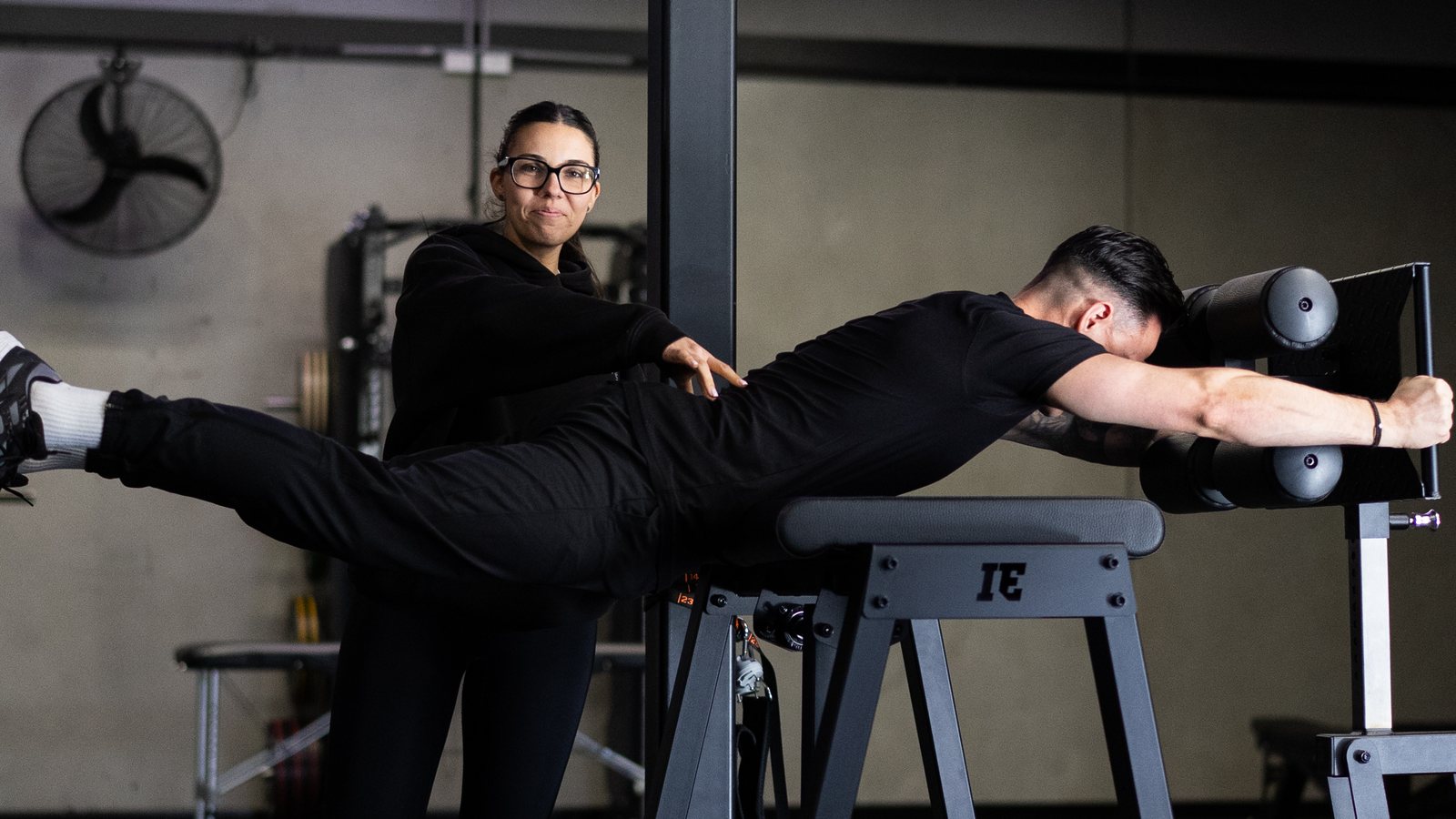
At IAC, the gym is not a separate phase after the clinical work finishes. The Ravenhall clinic has the treatment rooms and the rehab gym under the same roof for exactly this reason: hands-on treatment and loaded, measured, progressive strength and conditioning run alongside each other as one plan, not two appointments at two addresses with two sets of instructions. Our Altona clinic works to the same model.
One integrated team, one plan. Your testing data, your loading history, your sport demands and your training calendar all sit in the same place, which is the only way a criterion-based framework works in practice. If the person prescribing the squat does not know what your hop test looked like last Tuesday, the framework collapses back into guesswork.
What to ask before you go back
If you are coming to the end of a rehab block, ask three questions. What am I being measured against? What happens if I fail the test? And what is my plan for the eight weeks after I return, when risk is still elevated and nobody is watching anymore?
Good answers to those questions look like numbers, dates for retesting and an ongoing strength program. Vague answers usually mean a calendar is making the decision for you.
Returning to sport well is not about rushing or stalling. It is about knowing what you need, measuring whether you have it, and building the rest. That is how we try to keep the problem away rather than meeting it again next season.
Book a consultation at any of our Melbourne clinics to discuss your situation.
Related conditions & services
Ready to move better?
Book an appointment with our team and let's get to the root cause of what's bothering you.