

Blog / Tendonitis
Tendinopathy: Why Stretching Does Not Fix It, and What Does
Isometrics, heavy slow resistance and the science of tendon remodelling, applied to Achilles, patellar and rotator cuff pain.
November 2026 · 7 min read
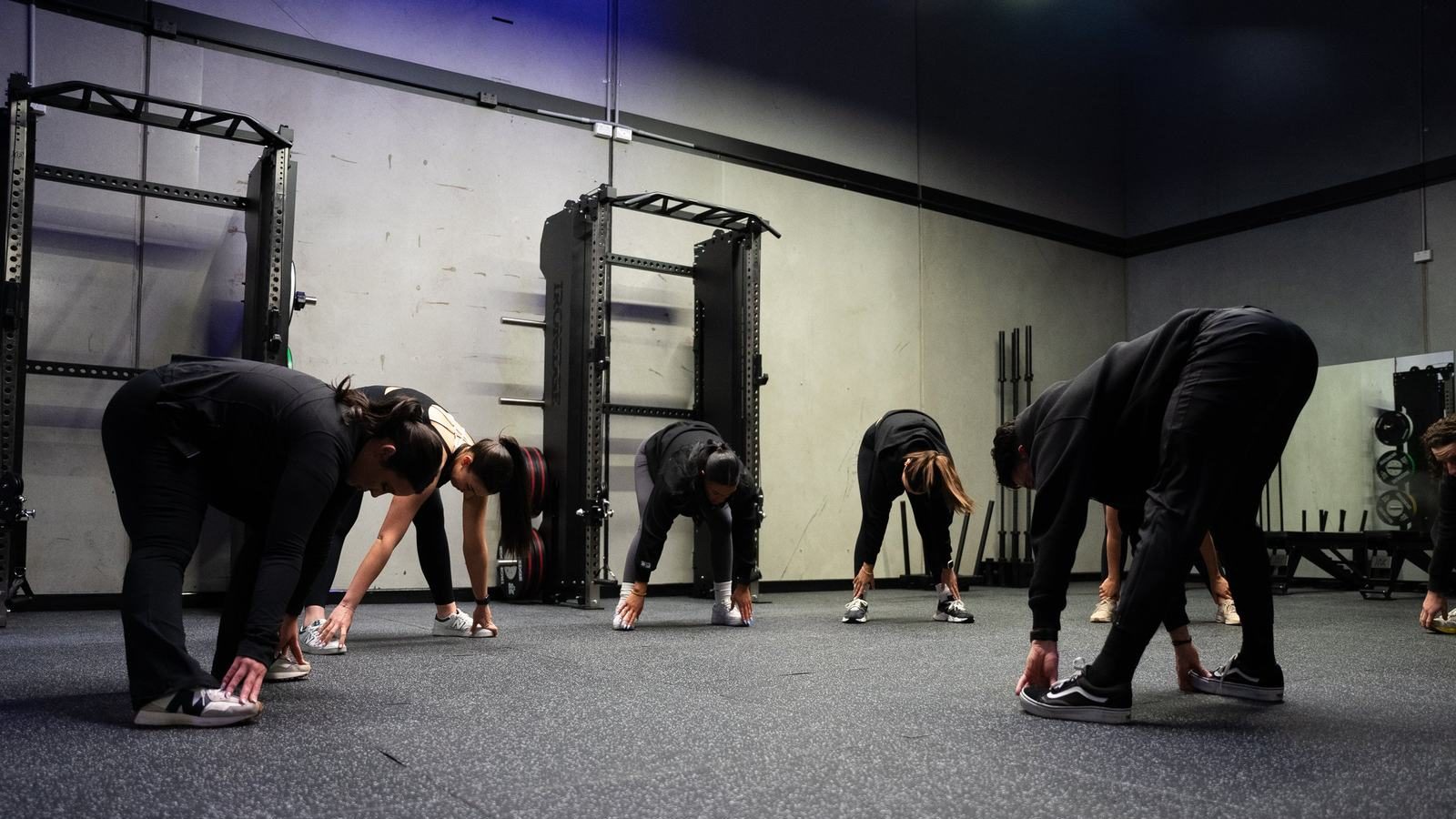
You have been stretching the calf against the wall twice a day for four months. The Achilles still bites for the first ten steps out of bed. Or the knee still aches on stairs, or the shoulder still catches when you reach into the back seat. You are doing something every day, and nothing is shifting.
That is one of the most common stories we hear in the clinic, and it is not a motivation problem. It is a dosage problem. Tendons respond to load, and stretching is not load in the way a tendon understands it.
Stretching treats the wrong problem
A painful tendon is not a short tendon. In most cases it is an under-prepared tendon that has been asked to do more work than its current capacity allows, usually after a spike in training, a change in footwear or surface, a new job role, or a return to sport after a layoff.
Stretching does two things. It creates a brief sensation of relief, which is genuinely pleasant, and it applies a long, low-level tensile pull to the tissue. What it does not do is deliver the high-magnitude, slow, repeated loading that drives collagen synthesis and tissue remodelling.
There is also a situation where stretching may actively irritate things. Cook and Purdam (2012) described the role of compressive load in tendinopathy, particularly where a tendon wraps around or inserts onto bone. Pulling the ankle into deep dorsiflexion compresses the insertional Achilles against the calcaneus. Pushing the arm into end-range elevation or across the body can compress the rotator cuff tendons. For insertional presentations, aggressive stretching is often the thing making the morning pain worse, not better.
None of that means stretching is banned. It means it is a comfort strategy, not a treatment. The treatment is load.
What is actually happening inside a painful tendon
Cook and Purdam (2009) proposed a continuum model that is still the most useful framework we have. At one end sits a reactive tendon: swollen, irritable, usually responding to a sudden spike in load, but structurally fairly intact. At the other end sits degenerative change: disorganised collagen, increased ground substance, new blood vessel and nerve ingrowth, and areas of tissue that are not doing much mechanical work at all.
Two things follow from that model, and both matter for your rehab.
First, the imaging rarely matches the pain. Plenty of people have thickened, disorganised tendons on ultrasound and no symptoms whatsoever. Plenty of people have significant pain with modest imaging findings. A scan report that says "degeneration" or "tendinosis" is describing tissue, not your prognosis.
Second, a degenerative tendon does not need to be returned to pristine structure for you to get better. The goal is to build capacity in the healthy tissue surrounding the affected area and in the whole kinetic chain that feeds it. That is a strength problem, which is good news, because strength is trainable.
Pain does not equal damage, but load is the language tendons speak
This is where a lot of people get stuck. The tendon hurts, so they rest it. The pain settles. They return to activity, the tendon has lost capacity during the rest, and the pain comes straight back. That loop can run for years, and each cycle leaves the tissue a little more deconditioned and the person a little more cautious.
Modern tendon rehab accepts a level of pain during loading. Silbernagel and colleagues have published extensively on a pain-monitoring approach for Achilles tendinopathy, where discomfort during and after exercise is permitted within a tolerable range, as long as it settles within 24 hours and morning stiffness is not progressively worsening week to week. Many patients find this single reframe changes everything, because it removes the fear that every twinge is fresh damage.
That is the practical face of pain does not equal damage. Not a slogan, but a rule you can use at the gym on a Tuesday night. You can read more about how we apply this across stubborn conditions on our conditions pages.
Isometrics: turning the volume down
Isometrics are sustained holds with no joint movement. Think a single leg calf raise held at mid-range, a Spanish squat held against a band, or an isometric external rotation hold at the shoulder.
Rio and colleagues (2015) found that isometric holds produced an immediate reduction in patellar tendon pain in athletes, along with a reduction in cortical inhibition, with effects lasting beyond the session. Follow-up research has been mixed on how reliably that analgesic effect reproduces across individuals and tendons, so it is best treated as a useful tool rather than a guarantee.
What isometrics reliably do is allow a highly irritable tendon to be loaded meaningfully without the repeated stretch-shorten cycle that often flares it. For an in-season athlete who cannot stop playing, or for someone whose tendon is too reactive to tolerate full-range work, this is the entry point. Typical prescriptions sit around four to five holds of 30 to 45 seconds at a moderate to heavy effort, performed once or twice daily.
Heavy slow resistance: where the remodelling happens
Isometrics manage symptoms. Heavy slow resistance (HSR) builds the tendon.
Alfredson and colleagues (1998) put eccentric loading on the map with their heel-drop protocol for Achilles tendinopathy, and it remains a reasonable option. But the more interesting work came later. Kongsgaard and colleagues (2009) compared corticosteroid injection, eccentric training and heavy slow resistance for patellar tendinopathy. At 12 weeks the injection group looked good. At 6 months they had regressed, while the HSR group had maintained their gains and showed favourable changes in tendon collagen. Beyer and colleagues (2015) ran a similar comparison in Achilles tendinopathy and found HSR comparable to eccentric training in outcome, with notably better patient satisfaction and lower time cost, because HSR is three sessions a week rather than twice daily.
Malliaras and colleagues (2013) reviewed loading programmes across Achilles and patellar tendinopathy and concluded that no single protocol is clearly superior, but that progressive, adequately heavy loading is the common ingredient.
In practice HSR looks like what it sounds like: squats, leg press, seated and standing calf raises, loaded shoulder work, performed with a slow tempo (roughly three seconds down, three seconds up), building from around 15 repetition loads towards 6 to 8 repetition loads over 8 to 12 weeks. It looks like strength training because it is strength training. That is the point. Strength and conditioning is not something you graduate to after rehab. In tendinopathy, it is the rehab.
Achilles, patellar and rotator cuff: same principles, different dose
The tissue rules are shared, but the application changes.
- Achilles. Mid-portion and insertional presentations behave differently. Insertional cases usually need range limited to neutral early on, avoiding the deep dorsiflexion that compresses the tendon against the heel bone. Calf capacity work needs both straight knee and bent knee variations.
- Patellar. Loves heavy slow squat and leg press patterns. Energy storage work (jumping, change of direction) is reintroduced deliberately and late, once strength is there to support it.
- Rotator cuff. Holmgren and colleagues (2012) showed that a specific progressive exercise programme significantly reduced the need for surgery in patients on a subacromial decompression waiting list. Littlewood and colleagues (2016) showed that a simple self-managed single-exercise loading approach produced outcomes comparable to standard physiotherapy. The shoulder responds to progressive load just like the lower limb, and it rarely responds to rest.
How we approach tendon pain at IAC
A tendon rarely gets overloaded by accident. Something upstream created the spike. A calf that cannot produce enough force, so the Achilles absorbs it. A hip and quad that fatigue early, so the patellar tendon takes the landing. A training week that jumped from 20km to 45km. A new role involving overhead work. We want that answer before we prescribe anything, because that is how you stop it returning. We find the cause. We fix the problem. We keep it away.
From there it runs as one plan under one roof, not a series of separate appointments. Hands-on work is used to make loading tolerable in the early irritable phase. Loading is progressed in the rehab gym at our Ravenhall clinic, in the same building, on the same day, with the same team tracking the same numbers. Our Altona clinic at 22 Reserve Court runs the same integrated approach. You can see how our services fit together as a single coordinated process rather than a set of handovers.
Tendons are slow. Meaningful change typically takes 12 weeks or more, and evidence suggests the people who do best are the ones who load consistently rather than perfectly. If you have been stretching for months and waiting for something to shift, the issue is probably not your commitment. It is the stimulus.
Book a consultation at any of our Melbourne clinics to discuss your situation.
Related conditions & services
Ready to move better?
Book an appointment with our team and let's get to the root cause of what's bothering you.