

Train With Pain #24: Knee Medicine, a Grumpy Achilles and Why Sleep Is a Strength Exercise
Poliquin steps, side planks, hip rotation, a 5km time trial and something coming in January.
October 2026 · 8 min read
Happy Friday
I've had a great week in clinic, seeing an incredibly mixed bag: ACL tears, talus fractures, acute lower back flare ups and hamstring strains. I jumped into 4 of the 5 classes this week and loved every minute. The classes have been busy, buzzy, intentional, and again, it's been great watching people trust us and take control of their injuries, strength and health.
If you're reading this and you're not a member yet, here's the thing. A knee that grumbles on the stairs, a back that tightens up after a long day at the desk, an old injury that never quite came good. That's exactly what we work on every day, in the clinic and in the gym, side by side. You don't have to choose between rest and pushing through. There's a middle path, and it starts with a free gym consultation. Book at injuryactive.com.au/gym.
Wednesday: Squat Day
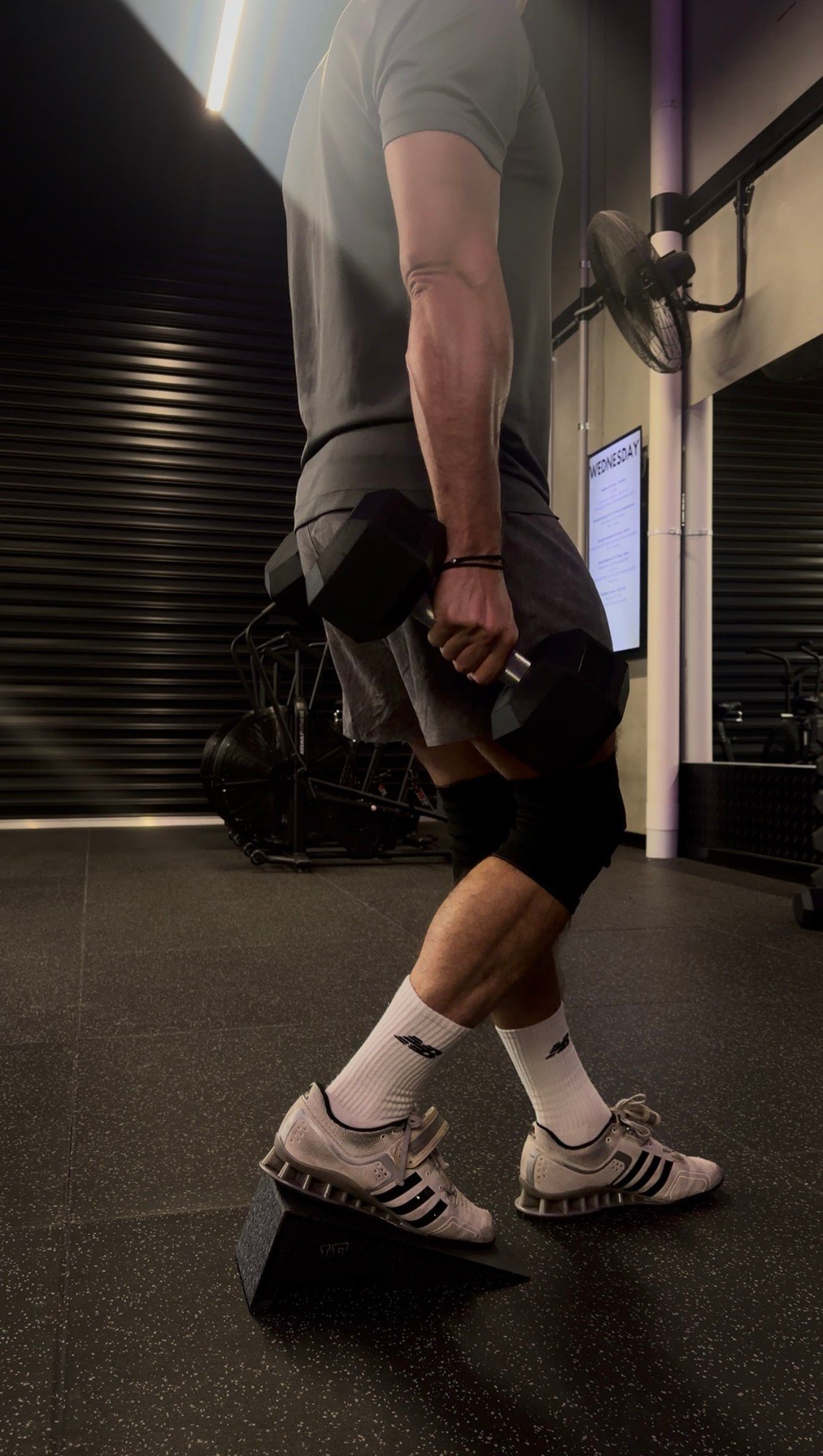
Wednesday was squat day. After some deadly sets of 12 on the back squat that left the legs absolutely fried, we followed up with this beautiful superset.
The Poliquin Step
Your working foot sits on a slant board, heel raised, dumbbells in hand. You slowly bend the knee and let it travel forward over your toes as far as you can control it, tapping the other foot down behind you, then drive straight back up. We ran it for 3 sets of 10 to 15 reps a side with a 20X0 tempo: two seconds on the way down, no pause at the bottom, then up as fast as you can.
The heel lift and the forward knee travel put your quads front and centre. Your knee bends deeply while it's carrying load, which is exactly the position many people with knee pain avoid, and exactly the position the knee needs to be strong in. Stairs, squatting down to pick something up, getting up off the floor: all of that happens with the knee bent and loaded. We build tolerance there gradually, rep by rep, rather than hoping it sorts itself out.
And the research backs this up. A large review by Øiestad and colleagues (2015) found that weak knee extensors, your quads, were linked to a higher risk of developing knee osteoarthritis. Another review in the British Journal of Sports Medicine (Neal and colleagues, 2019) found lower quad strength was one of the risk factors for patellofemoral pain, that achy pain around the kneecap. Strong quads are one of the best things you can give your knees.
Watching the class on Wednesday, you could see how hard this movement is when it's done properly. Slow, controlled, knee travelling right over the toes, legs shaking. It genuinely pleased me to see everyone getting their knee medicine.
The Elevated Side Plank
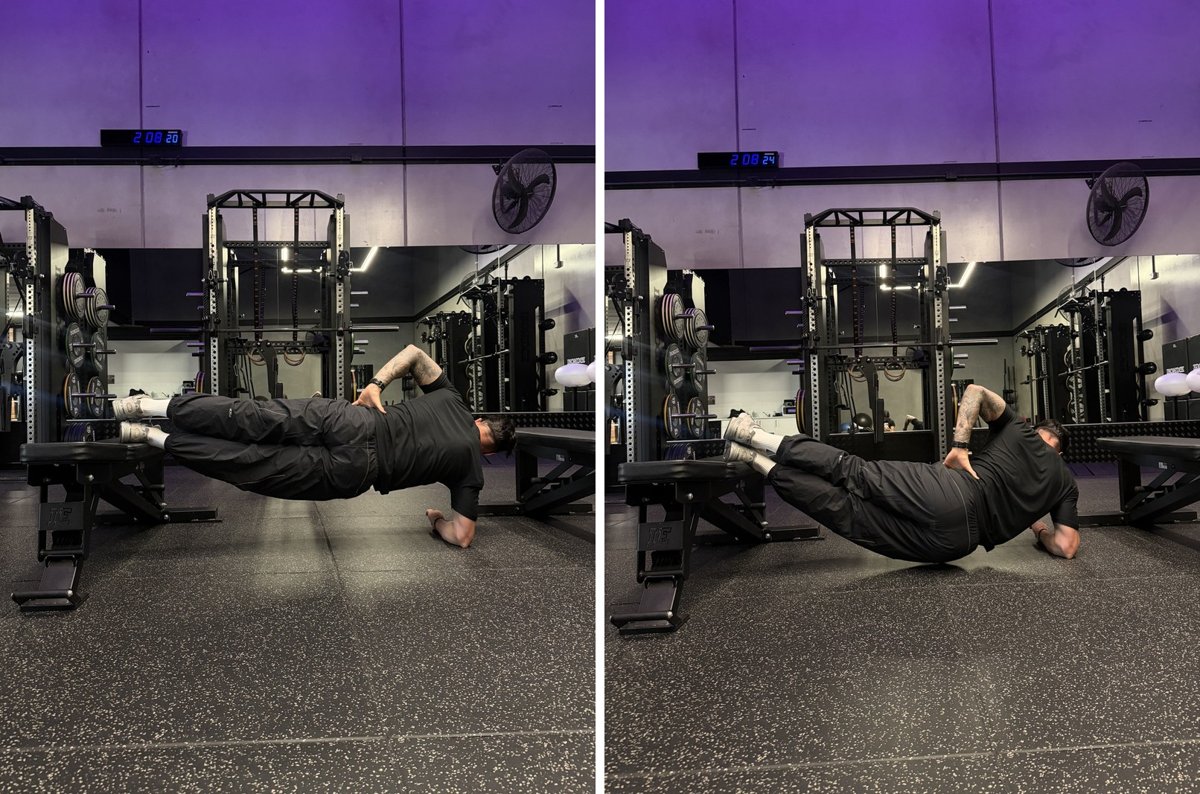
Paired with it was the elevated side plank with hip taps: feet up on a box, then lowering the bottom hip to tap the floor and driving it back up, 8 to 12 reps a side. It mainly targets the obliques, the muscles down the side of your trunk, strengthening your lateral core.
It's also a brilliant way to build strength and endurance in your quadratus lumborum, or QL, the deep muscle that runs between your pelvis and your lower ribs. When the QL is weak or tires quickly, it's often part of the picture with lower back pain. Professor Stuart McGill's research in the late 1990s showed the side plank switches the QL on strongly while keeping the load on the spine low. That's why it's one of our go to back exercises: lots of work for the muscles, very little stress on the discs.
Hips That Rotate
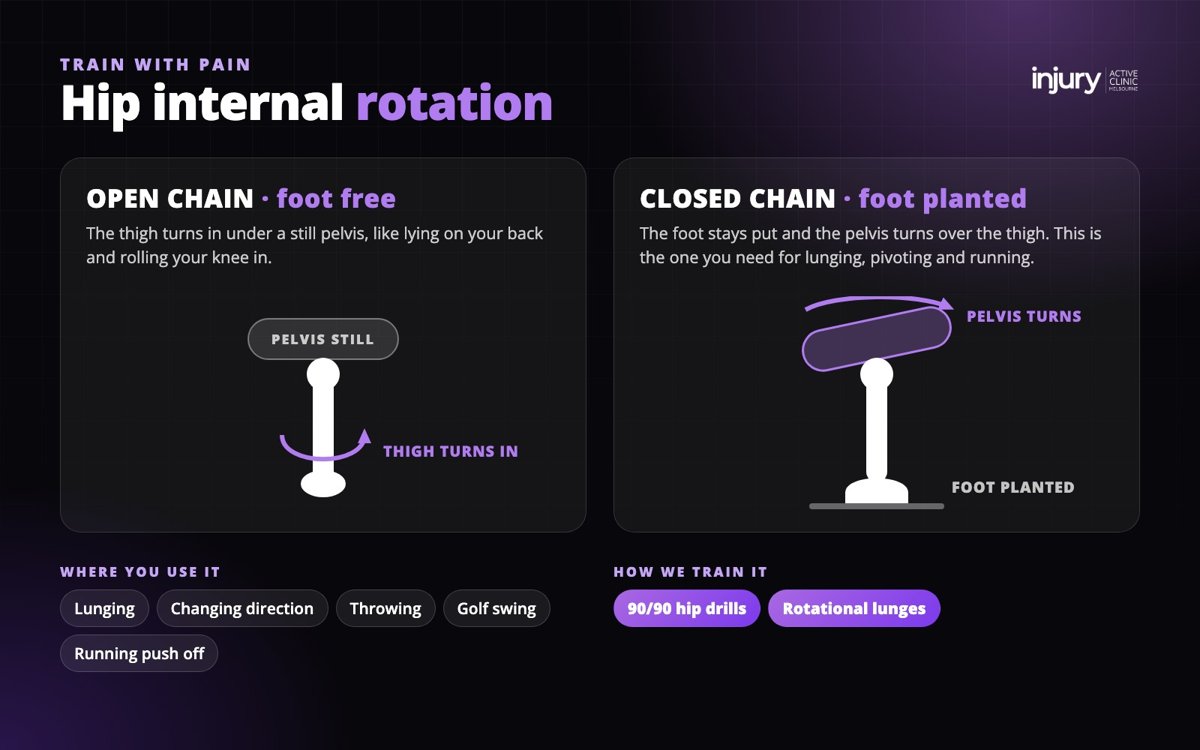
While we're on the lower body, let's talk about one of the most underrated qualities you can have: hip internal rotation.
Most people picture hip rotation as lying on your back and rolling your knee in. That's open chain, with the foot free. But most of the time we need it closed chain, with the foot planted on the ground and the pelvis rotating over the thigh bone. Every time you lunge, change direction, throw, swing a golf club or push off in a running stride, your hip has to internally rotate while your foot stays put.
When that rotation isn't available, the body finds it somewhere else, usually the knee or the lower back. Van Dillen and colleagues (2008) found that people with lower back pain who play rotation sports had less hip rotation than people without back pain. That's why you'll see 90/90 hip drills and rotational lunges in our warm ups. They aren't filler. They give your hips the rotation they need so your back and knees don't have to make up for it.
In the Training Cave
Strength work is going well. My bodyweight is sitting at 78 to 80kg and it's carrying over nicely into my strength numbers.
How's the running? I have to admit something. I've had a niggly right Achilles for the last month, and it's putting a little dark cloud over my running. I'm still getting the volume in, but I'm deliberately skipping the really hard, intense efforts, because I know they'd make it worse.
What I've most likely got is a reactive Achilles tendon. Tendons love load, but they like it introduced gradually. After my winter holiday I came back keen and ramped my running up quickly. My fitness bounced back faster than my tendon did, and the tendon responded by getting cranky. It's a really common story, and it's exactly what we see in clinic when people get excited about a new block of training.
I know what I need to do. Bring the intensity down, trim the volume a little, and do my calf and Achilles rehab. Am I doing it? Somewhat. I haven't seen the team for treatment... yet. I can get away with the running, but the next day it's stiff and sore, and that's the sign I need to listen to.
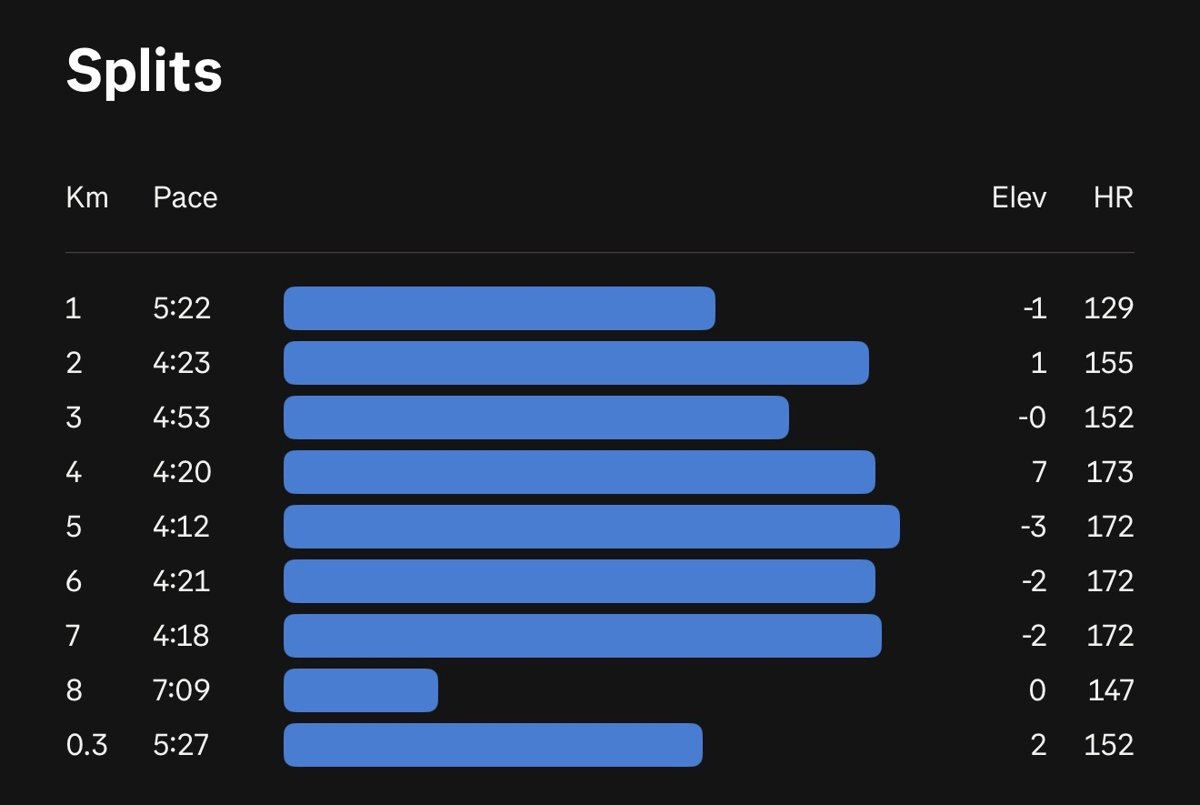
Yesterday was a 5km time trial, which I ran at about 90% because of the above. A 2km warm up, 2 minutes rest, then straight into a 5km effort around the lake. There are a couple of spots where the inclines aren't ideal for a time trial, but I took that into account. The effort settled at 4:12 to 4:21 per km, with my heart rate sitting around 172. Not my fastest, but controlled, which is exactly what I was after with a cranky Achilles.
Why a 5km time trial five weeks out from Hyrox? Hyrox is eight 1km runs with a station between each one, so knowing where my running fitness sits right now tells me exactly what pace I can hold on race day. It also gives me a benchmark with enough time left to adjust this last block of training. And the morning after is a useful check on how my Achilles is coping with a harder effort.
Sleep Is a Strength Exercise
We spend a lot of time talking about sets, reps and load. But some of your most important training happens when you're asleep.
Short sleep makes you more likely to get hurt. Milewski and colleagues (2014) found young athletes who slept less than 8 hours a night were 1.7 times more likely to be injured than those who slept more. Sleep also changes how you feel pain. Krause and colleagues (2019) found that one night of sleep loss made people noticeably more sensitive to pain, and showed changes in the parts of the brain that process it.
Then there's strength. The session is the stimulus, but the gains happen afterwards, while you recover. Train hard and sleep five hours, and you're leaving most of the benefit on the table.
So aim for seven hours or more. Keep a regular bedtime, put the phone away before bed, and keep caffeine to the morning.
And here's a little teaser. There's something coming in January that rewards you for your sleep, your steps and your training, and you'll be doing it with a team. More at the Christmas BBQ.
Why We Test You (and Why Once Isn't Enough)
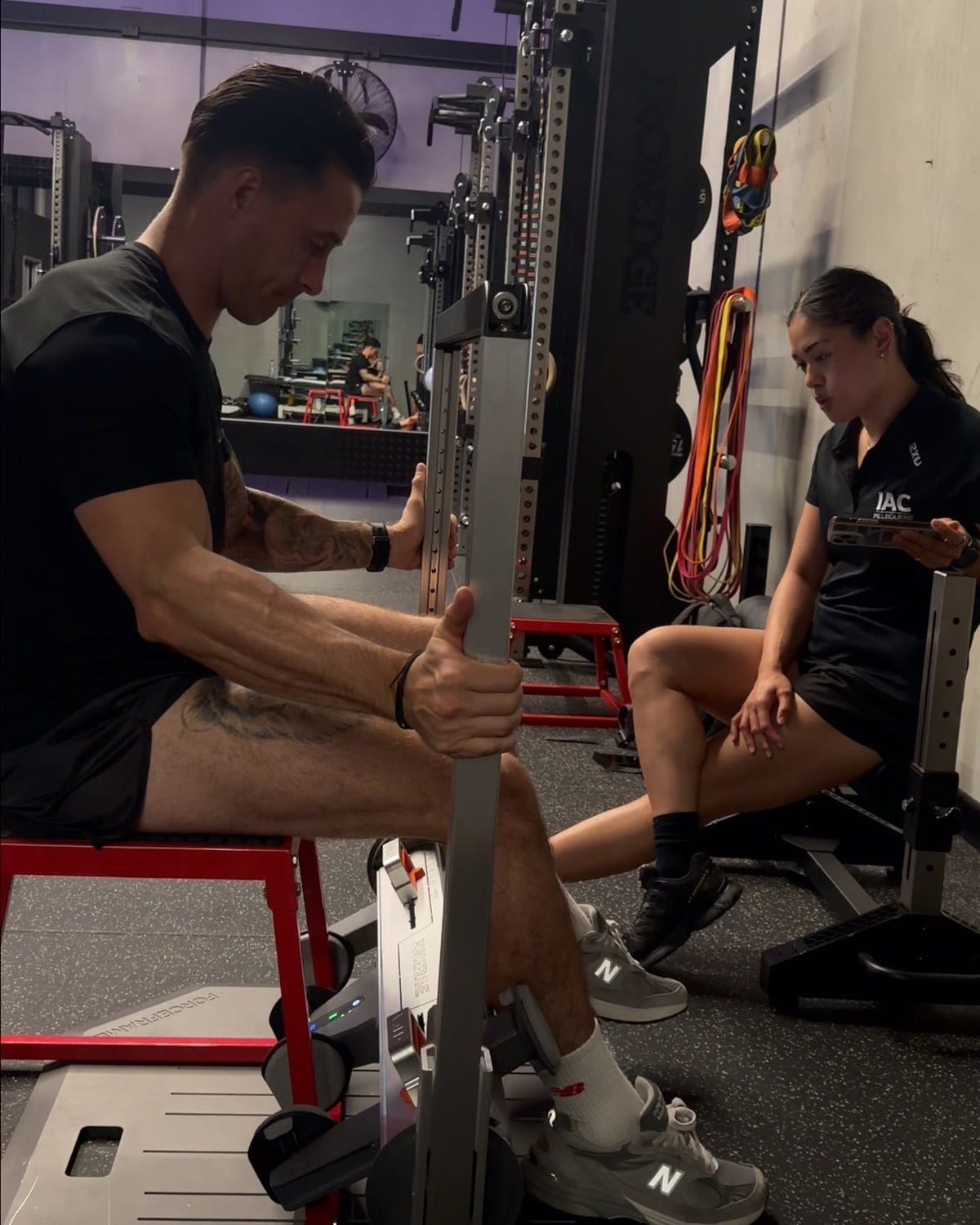
If you've been through our gym program, you've met the VALD ForceFrame. It's a fixed steel frame with force sensors that measures how strong your hips, knees, ankles and shoulders are. It also compares your left side to your right, and shows how quickly you can produce force, not just how much.
We test you in week one and again in week six. The biggest thing it tends to pick up is a difference between your left and right sides that you'd never notice day to day, especially after an old injury. And because the setup is identical every time, the numbers can be compared fairly, so you can actually see what's changed.
But strength isn't a one off. It changes with your training, your work, your injuries and your age. So in 2027 we're introducing a yearly strength check, a chance to retest and see how your body has changed over the year. More details soon.
Christmas BBQ
Save the date: Saturday 19th December.
We'll have a big class at 9:30am, followed by Rosetta Coffee and a BBQ from 10:30am. Book in via "Courses" in the app.
Have a great weekend.
Chat next week,
Craig
Related conditions & services
Ready to move better?
Book an appointment with our team and let's get to the root cause of what's bothering you.